
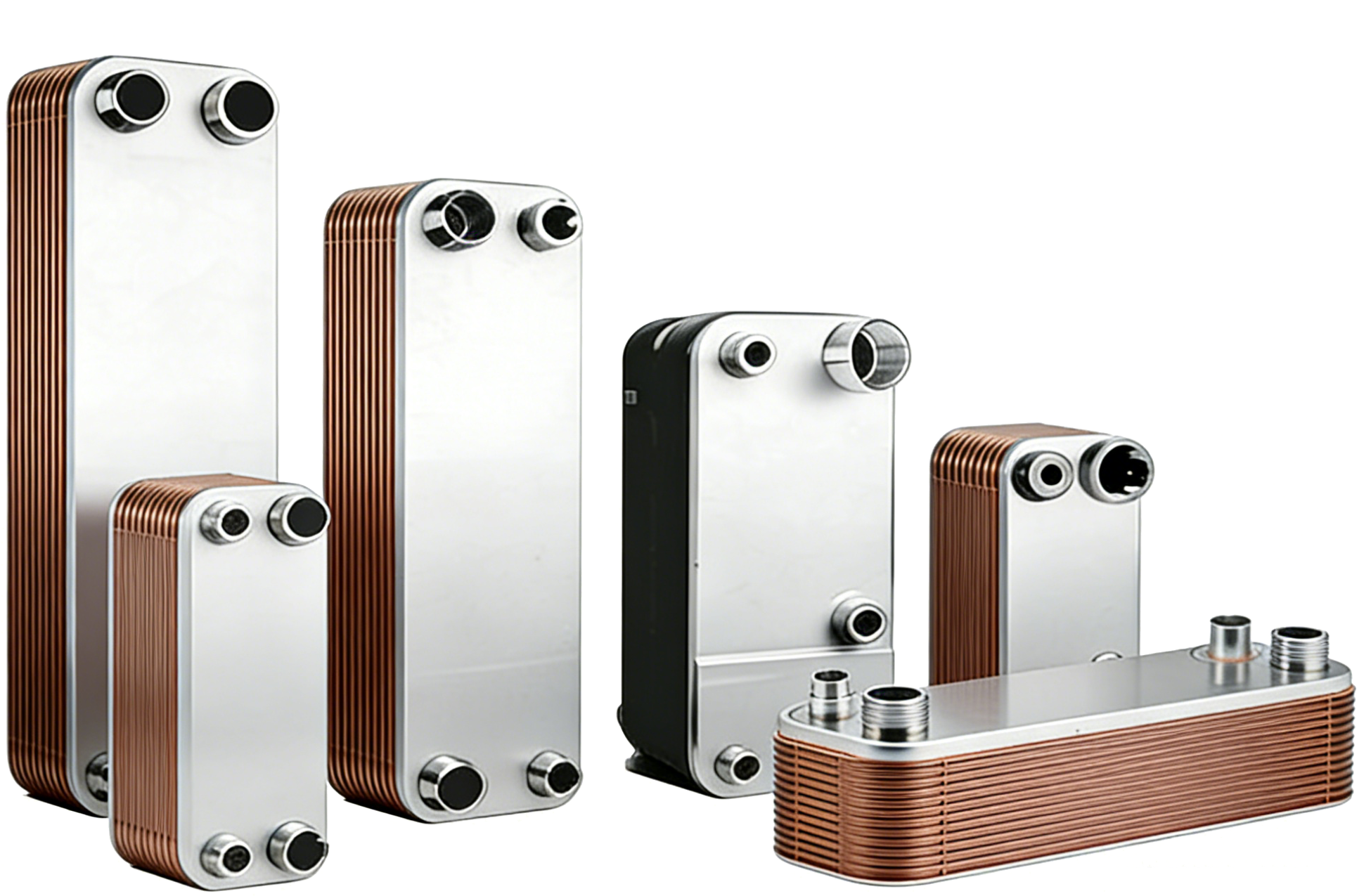
Brazed plate heat exchangers are highly efficient thermal exchange devices widely used in HVAC, industrial refrigeration, and waste heat recovery applications. Selecting the right model for your specific operating conditions is a common concern. This guide provides detailed selection recommendations.
Step 1: Define operating conditions
Before selection, please collect the following basic information:
Media Type:Water, oil, steam, refrigerants, etc.
Traffic:Volumetric or mass flow rate of the two media (m³/h or kg/h)
Temperature:Inlet/Outlet Temperature (°C)
Pressure:Working pressure (bar)
Allowable pressure drop:Maximum allowable pressure drop (kPa)
Step 2: Determine the heat exchange amount
Calculate heat exchange based on the law of conservation of energy:
Q = m × cp × ΔT
Where: Q is the heat transfer rate (kW), m is the mass flow rate (kg/s), cp is the specific heat capacity (kJ/kg·°C), and ΔT is the temperature difference (°C).
Step 3: Select Plate Material
Select material based on medium properties:
Stainless Steel 316L:Suitable for most standard applications with excellent corrosion resistance.
Stainless Steel 304:Low cost, suitable for areas with good water quality
Titanium:Suitable for seawater and media with high chloride ion content.
Hastelloy:Suitable for highly corrosive media
Step 4: Determine operating pressure and temperature
Working pressure and temperature range of brazed plate heat exchangers:
Standard: Working pressure ≤ 45 bar, working temperature ≤ 225°C
High-Temperature: Operating temperature up to 225°C
High-pressure model: Working pressure up to 50 bar (customization required)
Step 5: Consider the fouling factor
Select the appropriate fouling factor based on the cleanliness of the medium. Typical range:
Cleaning medium (e.g., water): 0.000017 m²·°C/W
Lightly contaminated medium: 0.000035 m²·℃/W
Contaminated medium: 0.000053 m²·℃/W
Step 6: Verify pressure drop
Calculate the actual pressure drop to ensure it stays within allowable limits. Excessive pressure drop increases pump energy consumption, while insufficient pressure drop may indicate inadequate heat transfer area.
Professional Selection Advice
Heat exchanger selection involves complex thermal calculations. We recommend:
Provide detailed operating parameters to technical professionals.
Calculate using the manufacturer's selection software
Include a safety margin (typically 10-15%)
For special operating conditions, experimental verification is recommended.
Yongdong Thermal Technology has a professional technical team that provides free selection services. Contact us for technical support.